
A missed salmon load does not just create a purchasing problem. It disrupts retail promotions, foodservice menus, production schedules, and margin planning across the chain. That is why norwegian salmon wholesale is not simply about finding fish at a competitive price. For serious buyers, it is about securing a supply partner that can deliver consistent quality, documented origin, and dependable export performance at scale.
Norwegian salmon remains a preferred category in international seafood trade for clear commercial reasons. It offers strong brand recognition in the market, reliable farming standards, high-volume availability, and a product profile that works across retail, foodservice, and industrial applications. But not every wholesale source offers the same value. The difference usually comes down to access, specifications, and logistics discipline.
Why Norwegian salmon wholesale stays in demand
Professional buyers do not choose origin on reputation alone. They choose it because origin affects yield, quality consistency, food safety confidence, and downstream customer acceptance. Norwegian salmon has maintained a strong position because the industry operates within a mature regulatory and production environment, supported by advanced farming practices and recognized standards around traceability and fish health.
For importers, distributors, supermarket chains, and restaurant groups, that matters in practical terms. A more predictable raw material means fewer quality disputes, less product variation between shipments, and better control over portioning, merchandising, and menu execution. If you are buying in volume, consistency often matters as much as headline price.
There is also the logistics factor. Norway has built export systems around seafood. That makes a difference when buyers need stable shipment planning, documentation accuracy, and cold-chain performance for international delivery. Premium seafood loses value quickly when logistics are treated as an afterthought.
What B2B buyers should expect from a wholesale supplier
In norwegian salmon wholesale, the supplier relationship should be structured around commercial reliability, not spot-market convenience. Buyers should expect more than product availability. They should expect a sourcing model that supports repeat business.
The first requirement is clear product specification. Wholesale salmon is not one standard item. Buyers may need fresh or frozen product, whole fish, fillets, trimmed portions, or HOG format depending on channel and processing needs. A retail buyer may prioritize visual appearance, shelf life, and pack consistency. An industrial buyer may care more about size range, fat content, and yield performance in further processing. A supplier that cannot align specification to end use is likely to create unnecessary cost further down the chain.
The second requirement is traceability. Origin claims are easy to make and harder to verify. Serious buyers need documentation that supports farm source, processing details, certifications where applicable, and export compliance. This is not only about audits. It is also about protecting customer relationships when questions arise around quality, sustainability, or product handling.
The third is delivery discipline. A wholesale supplier must be able to coordinate production, packing, and shipment in a way that protects freshness and arrival condition. Lead times, container planning, temperature control, and customs documentation all affect whether a shipment lands as planned. Strong logistics are part of the product.
Factory-direct sourcing changes the economics
One of the most practical advantages in norwegian salmon wholesale is direct access to farms and processing facilities. When the chain includes too many intermediaries, buyers usually pay more while receiving less visibility into actual supply conditions. Pricing becomes less transparent, communication slows down, and accountability can become blurred.
Factory-direct sourcing improves this in two ways. First, it can reduce cost by removing unnecessary trading layers. That does not mean the lowest quote always wins. It means buyers have a better chance of getting pricing that reflects real product value rather than compounded markups. For volume purchasers, that difference is material over a long contract period.
Second, direct sourcing tends to improve operational clarity. Buyers can work against actual production capabilities, available formats, and realistic shipment schedules. That matters when planning promotions, managing inventory, or locking in recurring deliveries. A supplier with direct factory access is generally better positioned to give accurate answers on what can be supplied, in what form, and on what timeline.
This is where companies such as Nordpoll Seafood are positioned differently from retail-style seafood marketplaces. The focus is not on small transactional orders. It is on factory prices, large-volume supply, and export-ready coordination for business buyers that need continuity.
Product formats that support different channels
A good wholesale program should match product format to buyer need rather than forcing every customer into the same pack style. In practice, most commercial demand centers around fresh and frozen salmon in several core presentations.
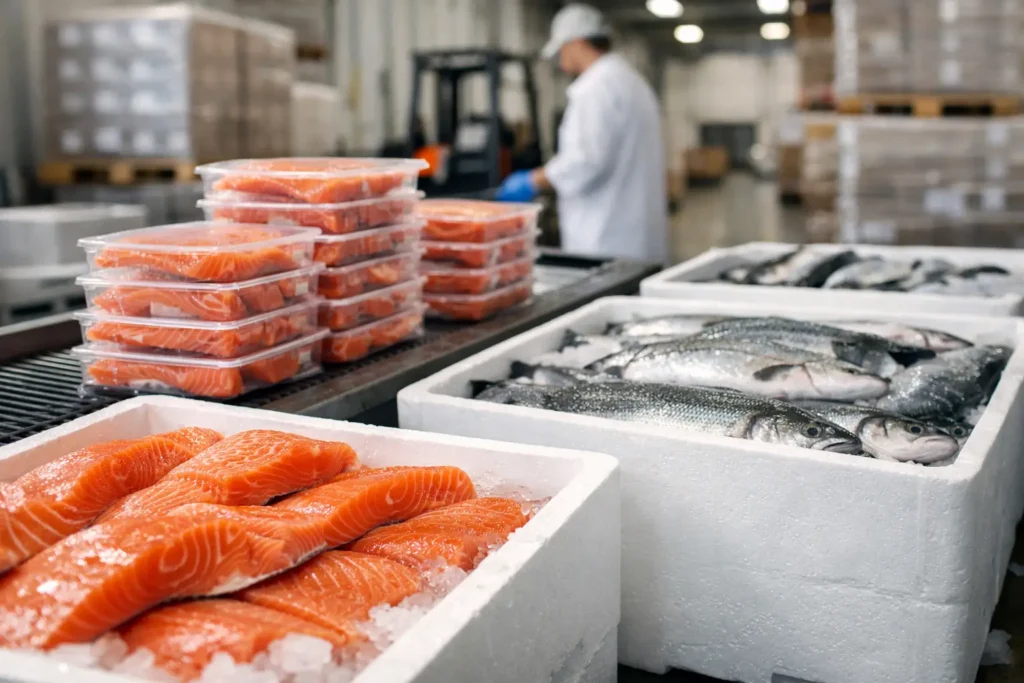
Whole fish works well for certain distributors, processors, and traditional seafood counters where flexibility in cutting is important. HOG product is often a practical option for buyers balancing processing efficiency with cost control. Trimmed fillets and other processed formats are better suited to operations that need labor savings, standardized presentation, or portion-ready input.
Fresh product supports premium retail and foodservice programs where appearance and shelf life are central. Frozen product can be the better commercial choice for longer transit routes, industrial use, and customers prioritizing inventory flexibility. There is no universal best format. It depends on destination market, lead time tolerance, cold storage capacity, and final application.
A capable wholesale supplier should discuss these trade-offs directly. Paying more for fresh fish only makes sense if the downstream channel captures that value. In some cases, frozen product delivers stronger total economics with less waste and more predictable planning.
The quality conversation is more specific than “premium”
Every seafood supplier claims quality. Buyers need to define what quality means in measurable terms. In norwegian salmon wholesale, quality should be assessed through consistency in size grading, flesh color, texture, trim standard, glazing where relevant, temperature control, and overall condition on arrival.
For foodservice, premium quality may be judged by cut performance, visual presentation, and eating experience. For retail, it may center on shelf appearance, drip loss, and pack uniformity. For industrial processors, the focus may shift toward yield, fat profile, and input stability. These are different commercial realities, and the supplier should understand them.
This is why broad marketing language is not enough. Buyers should expect precise communication about product standards and a willingness to align supply with specification. That includes being candid about seasonal factors, size availability, and the occasional limits of a given production window. Reliable supply partners do not overpromise to win short-term business.
Logistics and compliance are part of wholesale value
International seafood trade is won or lost in execution. Product may leave Norway in excellent condition and still create problems if paperwork is incomplete, packing is inconsistent, or shipment handling fails during transit. For US buyers and other global importers, export competence is a purchasing criterion, not an added benefit.
A supplier in norwegian salmon wholesale should be equipped to support health documentation, customs-related requirements, and shipping coordination that protects product integrity from plant to destination. Cold-chain performance matters at every handoff. Even small deviations can affect shelf life, customer acceptance, and claim rates.
This is especially important for buyers managing multiple locations or high-volume programs. One delayed or mishandled shipment can affect more than one account. The right export partner helps reduce that exposure through disciplined fulfillment and realistic communication around schedules and contingencies.
How buyers should evaluate a long-term supplier
The best wholesale relationship is not built on one attractive quote. It is built on repeatable performance. Buyers should evaluate suppliers on pricing structure, yes, but also on consistency, responsiveness, product knowledge, and ability to scale with demand.
A useful question is whether the supplier understands your business model. A supermarket program, a seafood distributor, and a processor do not buy the same way. If a supplier only talks about product and not your operational needs, there may be a gap later in execution.
Another good test is how the supplier handles specifics. Can they explain available formats clearly? Can they speak in practical terms about shipment planning, lead times, and documentation? Can they support traceability and sustainability expectations without vague language? Serious suppliers usually answer commercial questions with commercial detail.
Price still matters, of course. But the lowest-cost source is not always the lowest-cost decision. Quality variation, weak logistics, and poor communication can erase any savings quickly. In seafood wholesale, stable performance often protects margin better than aggressive but unreliable pricing.
For buyers sourcing at scale, the real opportunity in norwegian salmon wholesale is not just access to premium fish. It is access to a supply model that combines factory-direct pricing, traceability, export readiness, and dependable fulfillment. When those pieces are in place, purchasing becomes less reactive and more strategic, which is exactly where a long-term seafood program should be.